
Welcome back to A Little Wiser. Thanks for all the feedback on recent editions. Please feel free to reply with any topics you’d like to see covered soon! Today’s wisdom explores:
The Rise and Fall of Fake Meat
Why the Voice Inside Your Head Is Losing You Points
How Record Labels Get Rich While Artists Don't
Grab your coffee and let’s dive in.
HEALTH
🥩 The Rise and Fall of Fake Meat
The plant-based meat industry entered its golden era on May 2, 2019, when Beyond Meat went public on the Nasdaq with the best opening day performance for a major US IPO in nearly two decades. The company had been founded by Ethan Brown in 2009 with the ambition of creating meat entirely from plants, and the timing of the IPO landed at the precise confluence of climate anxiety and widespread consumer belief that plant-based eating was both healthier and more sustainable. Impossible Foods, founded by Stanford biochemist Pat Brown in 2011, had taken a different technical approach in engineering a molecule called heme from fermented yeast to replicate the meaty flavor of a beef burger. Both companies attracted extraordinary investment. McDonald's tested a McPlant burger in partnership with Beyond Meat, Burger King launched the Impossible Whopper and most grocery stores built dedicated plant-based sections. The category appeared to be one of the most durable consumer trends of the decade.
The collapse, when it came, was swift and revealing. Beyond Meat's revenue peaked in 2021 and then fell for four consecutive years, dropping 10 percent in 2022, 18 percent in 2023, and continuing to decline through 2024 and 2025. Impossible Foods also suffered failures as it wrote down its valuation by more than half. The reasons for the reversal cut across several fronts simultaneously. The products were significantly more expensive than real meat, a gap that became particularly damaging when inflation drove consumers back toward the cheapest protein available. The health positioning turned out to be questionable: plant-based burgers are highly processed products with sodium levels and ingredient lists that many nutritionally aware consumers found difficult to reconcile with the clean-eating identity the category had borrowed. And the taste, despite genuine advances in food technology, never fully convinced the mainstream buyers the industry needed to sustain its growth.
What the episode exposed was the difference between a cultural moment and a durable market. The early adopters, vegans, environmentally motivated millennials, and the curious, bought enthusiastically. The mass market tried the products once or twice and returned to animal protein. Even households that continued buying plant-based options in 2024 were doing so as a supplement rather than a replacement. The category as a whole is not finished. However, the idea of a world in which plant protein systematically displaces animal agriculture at scale has, at least for now, run directly into the limits of what people are actually willing to eat on a Tuesday evening when the alternative costs half the price.

PSYCHOLOGY
🎾 Why the Voice Inside Your Head Is Losing You Points
When a Californian tennis coach called Timothy Gallwey published a short book about the mental side of sport in 1974, he could not have predicted that executives, surgeons, musicians, and athletes across every discipline would still be reading it fifty years later. Bill Gates has listed it among his all-time favorite books, Billie Jean King called it her tennis bible, Al Gore used it to focus his campaign staff. The reason they do is because Gallwey had inadvertently written one of the most precise descriptions of how the human mind interferes with human performance ever put on paper. His central formula was blunt: performance equals potential minus interference. The greatest obstacle between a person and their best work is the noise generated by their own thinking.
Gallwey divided the mind into two distinct voices he called Self 1 and Self 2. Self 1 is the conscious, analytical, judgmental narrator that issues instructions, evaluates every action, and delivers verdicts about what just went wrong. Self 2 is the body's natural intelligence, the accumulated system of muscle memory, intuition, and instinct that already contains everything needed to perform. The problem is that Self 1 does not trust Self 2, and so it constantly interferes with it. A tennis player lines up to serve and Self 1 floods the nervous system with simultaneous commands, bending the knees, tossing the ball higher, following through, producing a tighter and more hesitant movement than if the player had simply let their body do what it already knew how to do. Gallwey taught his students to quiet Self 1 by giving it something neutral to occupy itself, watching the seams of the ball, noticing the sound of contact, anything that absorbed the analytical mind without directing the body. When Self 1 was occupied, Self 2 was free to perform.
The lesson travels directly into daily life. Before a difficult conversation, a presentation, or any high-stakes moment, the instinct is to run through instructions and mentally rehearse every variable. Gallwey's insight suggests that picking a single, simple focal point, the tone of your voice, the pace of your breathing, the feeling of your feet on the floor, and committing attention to that alone. This frees the deeper competence you have already built to operate without obstruction. The second lesson the book offers cuts even deeper. Most people assume that harsh self-criticism after a mistake functions as useful quality control, a form of internal pressure that raises standards over time. Gallwey argued the opposite. Judgment, whether positive or negative, pulls attention away from what is actually happening and toward an evaluation of how well or badly it happened, which are two entirely different cognitive operations. The body learns faster from clean observation than from emotionally charged criticism, because observation generates accurate information and criticism generates noise. The book's most enduring contribution to psychology is that counterintuitive premise that the harshest opponent most people will ever face across their entire lifetime is the one living inside their own head, and that learning to quiet it is a more valuable skill than almost anything else they will ever practice.
Reply Tennis to this email if you’d like me to send you a clear one page mind map summary of the book!
Below - NBA star Jared McCain shows a reporter his favorite passage from the original book he reads before every game.

MUSIC
💿 How Record Labels Get Rich While Artists Don't
"You realized that you were really in one of the sleaziest businesses there is, without actually being a gangster. It was a business where the only time people laughed was when they'd screwed someone else over." — Keith Richards, Life (2010)
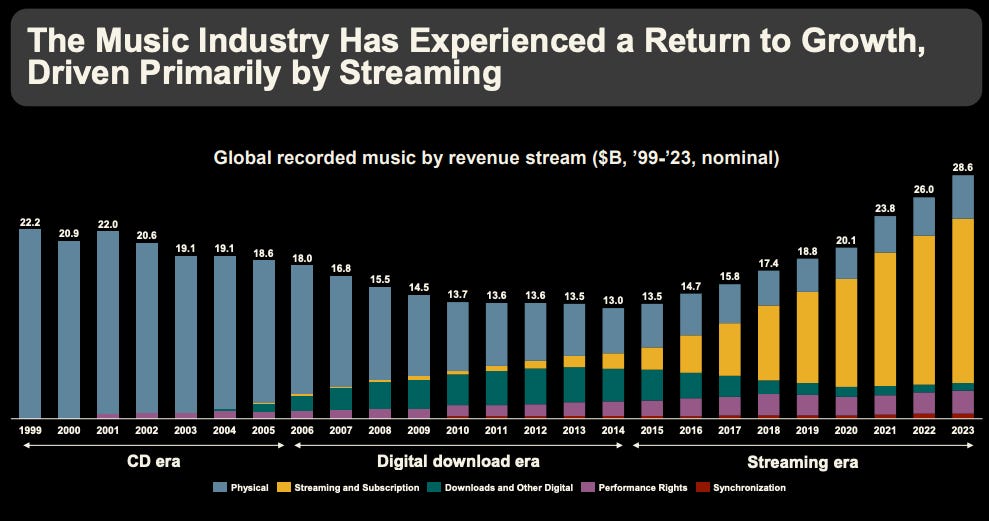
For most of the 20th century, a record label's business model was simple. Advance money to an artist, own the master recordings that resulted, and recover that investment through physical sales, retaining the majority of revenue until every penny was recouped. At the peak of the CD era in 2000, the US music industry generated $14.6 billion annually, almost entirely from physical product. Then Napster arrived, file sharing dismantled the revenue base within a decade, and the industry was forced to fundamentally reinvent itself. The solution the major labels landed on was the 360 deal, pioneered by EMI's £80 million contract with Robbie Williams in 2002. This extended the label's financial claim beyond recordings to cover a percentage of every revenue stream an artist generates including touring, merchandise, brand endorsements, publishing, and eventually social media income. Williams later described the arrangement as suffocating, refusing to tour in support of his EMI material by 2006. The deal had given the label too much control, and it became the cautionary example every artist's lawyer referenced for the next decade.
The explosion of streaming apps has created its own dynamics: Spotify pays rights holders between $0.003 and $0.005 per stream, with the label taking its contracted share before passing the artist their royalty percentage after recoupment. Under a standard major deal, an artist receives between 10 and 20 percent of recording revenue, meaning they need roughly 1.25 million streams to earn $1,000. To put that in concrete terms, a song that a person genuinely loves and has listened to fifty times has generated its creator less than twenty cents in total. The three major labels, Universal, Sony, and Warner, control an estimated 68 percent of the global recorded music market and negotiate direct licensing rates with platforms that smaller labels simply cannot access. What makes the structure particularly lopsided is that the label owns the master recordings permanently, meaning it continues collecting revenue from an artist's work indefinitely, long after any advance has been recouped, long after the artist has left the label, and in many cases long after the artist has died.
What makes the history of record contracts genuinely fascinating is the ingenuity artists have deployed to escape them. Prince wrote the word SLAVE on his face in the 1990s, changed his name to an unpronounceable symbol to make himself contractually unusable, and flooded the market with vault releases until Warner Bros effectively gave up and let him go. Frank Ocean executed something more surgical. Having spent years neglected on Def Jam while quietly building into one of the most critically revered artists of his generation, he released Endless in 2016, a deliberately obscure visual album that technically fulfilled his contract, then dropped Blonde independently the very next day through Apple Music for a reported $20 million. It is a playbook with a clear lineage. Taylor Swift, whose original masters were sold to Scooter Braun without her consent when Big Machine Records was acquired in 2019, responded by re-recording her entire first six albums from scratch. The campaign was so successful that the re-recorded versions outperformed the originals on streaming and in 2025 she finally acquired the original masters herself. Labels have since extended re-recording restriction clauses in new contracts from the previous five-to-seven-year window to as long as thirty years, a direct response to Swift's success and the most visible evidence that the balance of power between artists and labels is shifting in ways the industry is still scrambling to contain.
Below - a great read we found when researching this lesson.
We hope you enjoyed today’s edition! If you did, feel free to share it on social media or forward this email to friends.
Until next time... A Little Wiser Team
Key takeaways
The Rise
Fall of Fake Meat
Why the Voice Inside Your Head Is Losing You Points
FAQ
Q: What is The Rise?
A: The Rise is covered in this A Little Wiser edition.
Q: What is Fall of Fake Meat?
A: Fall of Fake Meat is covered in this A Little Wiser edition.
Q: What is Why the Voice Inside Your Head Is Losing?
A: Please feel free to reply with any topics you’d like to see covered soon!
Q: Why learn about The?
A: The Rise is covered in this A Little Wiser edition.
About the authors
Primary: Lucas Garcia (Harvard Philosophy). A Little Wiser editions are written with Lucas Garcia (Harvard Philosophy), Callum Graham (Bristol Economics), Janet Gelder (Professor of History, University of Hawaiʻi), and Louise Graham (PhD Researcher, University of Texas).