
Sponsored by

Welcome back to A Little Wiser. We hope you're having a great week!
The countdown is officially on: next Friday, everything we've been teasing finally arrives. We've spent months in conversations with over seven incredible partners, and our team has been building features we think you're going to love. After a year researching and crafting over 500 lessons, The Athenaeum is coming soon!!!
Today's wisdom explores:
Why "Lie Detectors" Cannot Detect Lies
What Your Gym Clothes Are Really Made Of
Cognitive Dissonance and the Mind's War With Itself
Grab your coffee and let’s dive in.
CRIME
🔬 Why "Lie Detectors" Cannot Detect Lies
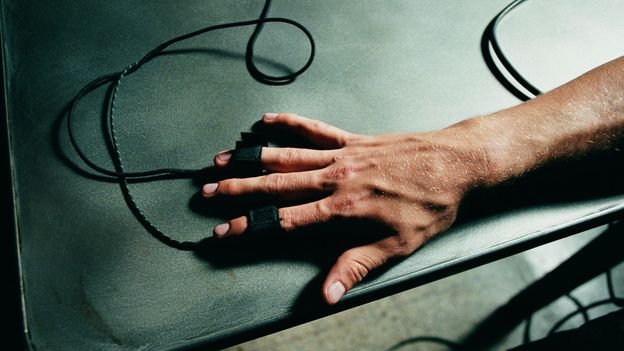
The lie detector was born from a simple and seductive idea, that the act of lying leaves a physical mark the body cannot hide. Its roots trace to a Harvard psychologist and lawyer named William Moulton Marston, who argued in the 1910s that a rise in blood pressure betrayed deception. The first true machine was built in 1921 by John Augustus Larson, a rookie Berkeley police officer who happened to hold a PhD in physiology. He wanted to make policing more scientific and to end the brutal "third degree" interrogations of the era, in which confessions were beaten out of suspects with fists and rubber hoses. His contraption continuously recorded a subject's blood pressure, pulse, and breathing on a rolling drum of paper. His younger colleague Leonarde Keeler soon refined it into a faster, portable device, added a sensor for sweat, and gave it the name we still use, the polygraph, meaning "many writings."
A polygraph detects arousal. It measures the physical signs of stress, such as a quickening pulse, rising blood pressure, shallow breathing, and sweaty fingertips. The whole method rests on the assumption that lying makes a person nervous in a way that telling the truth does not, and that assumption simply does not hold. An innocent person, terrified of being wrongly accused, may react exactly like a guilty one. A calm, practiced liar or a psychopath with a low stress response may sail through untroubled. Even Larson, its own inventor, grew disillusioned, found his results inconclusive around 40 percent of the time, and later reportedly called the device a monster he had created.
This is why, more than a century on, polygraph evidence remains barred from most courtrooms. The very first attempt to admit it, in the 1923 case of a man named James Frye, was rejected by a judge who ruled that lie detection was not established scientific knowledge. That decision produced the influential "Frye standard" still used to weigh expert evidence. Decades later the US Supreme Court noted that the scientific community remains deeply divided on whether polygraphs work at all. Yet the machine has never gone away, because the belief in it is more powerful than the evidence against it. Governments and intelligence agencies still use it to screen employees, and its greatest usefulness may be as a psychological prop, since a suspect who believes the box can read his mind is more likely to confess. In a strange twist, Marston went on to channel his faith in the device into fiction, creating the comic hero Wonder Woman and her Lasso of Truth.
10K Steps Is a Myth–Try This Instead

When motivation is lacking, jumping into heavy routines is the fastest way to burn out. That’s why millions of people are turning to walking as the foundation of their fitness journey.
Walking lets you enjoy the outdoors, clear your head, and practice mindfulness. It’s simple, sustainable, and can support lasting weight loss if you know how much you need. The “10,000 steps a day” rule is outdated; everyone’s lifestyle is different.
With Simple, you’ll get access to habit-based coaching that’s helped users lose over 18 million pounds. Take the quiz to discover your personalized walking target.
LIFESTYLE
👕 What Your Gym Clothes Are Really Made Of
The vast majority of modern sportswear is, in a literal sense, made from plastic. Polyester, the world's most common clothing fiber, now accounts for around 59 percent of all global fiber production. It is simply polyethylene terephthalate, or PET, the very same material used to make disposable water bottles, spun into thread. Its appeal to athletes is obvious, since it is cheap, durable and stretchy. The base PET polymer is itself chemically stable and inert, which is the reassuring part. The complication is that a finished pair of leggings or a running shirt is rarely just polyester. Turning raw plastic into performance wear involves a cocktail of chemical finishes, including dyes, anti-odor silver treatments, wrinkle-resisting formaldehyde resins, and often PFAS, the "forever chemicals" prized for repelling water and stains.
The health questions arise from what that plastic sheds and leaches, especially under the conditions of exercise. Heat, sweat, and friction, precisely what a workout generates, appear to increase how much of a garment's chemistry transfers to the skin. A 2023 University of Birmingham study found that a sweat-mimicking solution could leach hazardous chemicals, including flame retardants, out of synthetic microfibers, with the oily parts of sweat helping to draw them out. Separately, the Center for Environmental Health tested 47 items of activewear and found PFAS at levels up to 19 times California's safety threshold. These compounds are linked in the wider literature to thyroid problems, immune suppression, and elevated cancer risk. Polyester garments can also carry endocrine-disrupting additives like antimony, BPA, and phthalates, which studies indicate can migrate onto skin during wear.
It is worth keeping a level head here, since much of the loudest warning comes from brands selling natural-fiber alternatives, and regulators still classify the chemical levels in everyday clothing as low-risk. The more firmly established problem is environmental. Synthetic fabrics shed microplastics relentlessly, with a single polyester wash releasing hundreds of thousands of microfibers into the water system, and these particles now turn up in human blood, lungs, and placentas. For anyone wanting to reduce exposure without fear, the sensible steps are simple. Wash new synthetic clothes before the first wear to strip surface residues. Choose natural fibers like organic cotton, merino wool, or bamboo for anything worn against the skin during heavy sweating. Look for certifications such as OEKO-TEX that limit harmful finishes. The plastic shirt will not harm you the moment you put it on, but given how much time athletes spend sweating inside these fabrics, a little caution about what touches the skin is reasonable rather than alarmist.

PSYCHOLOGY
🧠 Cognitive Dissonance and the Mind's War With Itself
The story of one of psychology's most important ideas begins with a doomsday cult. In 1954, a Chicago housewife named Dorothy Martin convinced a small group of followers that aliens had warned her the world would end in a great flood on 21 December, and that a flying saucer would rescue the true believers beforehand. Some had quit their jobs, left their spouses, and given away their possessions. Watching all this was a young social psychologist named Leon Festinger, who quietly infiltrated the group to see what would happen when the prophecy failed. He expected that when the spaceship did not arrive and the world did not end, the most committed members, rather than admitting they had been fools, would believe even harder. That is exactly what happened. The group announced that their faith had persuaded God to spare the planet, and they began fervently recruiting new members. From this strange episode Festinger built his 1957 theory of cognitive dissonance.
The idea at its core is simple and profound. Human beings have a deep need for their beliefs, attitudes, and actions to line up in harmony, and when two of them collide, the clash produces a real mental discomfort that we are driven to relieve. The fascinating part is how we choose to relieve it. Changing our behavior is hard, so we very often change our beliefs instead, quietly rewriting what we think in order to justify what we have already done. Festinger proved this with a now-famous 1959 experiment. He had people perform an achingly dull task, turning wooden pegs for an hour, then paid them either $1 or $20 to tell the next participant it had been fun. Those paid a generous $20 still thought the task was boring, because the money gave them an easy reason to lie. But those paid a mere $1 had no such excuse, so to resolve the discomfort of lying for almost nothing, they genuinely convinced themselves the task had been enjoyable after all.
Once you understand dissonance, you begin to see it everywhere. It is why people who endure a brutal, humiliating initiation to join a fraternity or a club end up valuing their membership more, not less. The mind reasons that nobody would suffer so much for something worthless, a pattern confirmed in a 1959 study by Elliot Aronson and Judson Mills. It explains the smoker who insists the health risks are overblown, the shopper who suddenly finds extra reasons to love the expensive thing they just bought, and the difficulty any of us have in admitting we were simply wrong. The feeling that you are twisting logic to defend a past decision is worth noticing, because the moment you catch your own mind manufacturing excuses is the rare moment you get to choose the truth over your own comfort.

Enjoyed today’s edition?
If you found it valuable, the single best thing you can do is share it with one person who would enjoy it. Every referral helps us grow and keeps the lessons coming.
— Share A Little Wiser —
Until next time — stay curious.
The A Little Wiser Team