
Welcome back to A Little Wiser. We hope everyone is having a great week. Today's wisdom explores:
The Cathedral That Took Six Generations to Build
Why Chili Feels Hot When Nothing Is Burning
Simone de Beauvoir and the Making of Modern Feminism
Grab your coffee and let’s dive in.
ARCHITECTURE
⛪ The Cathedral That Took Six Generations to Build
Barcelona's most famous church is not, strictly speaking, its cathedral, yet the Sagrada Família has become the soul of the city all the same. Construction began in 1882 as a conventional Neo-Gothic project, but everything changed the following year when a young Catalan architect named Antoni Gaudí took charge. What he conceived was unlike anything in the history of architecture: a soaring stone forest where columns branch like trees toward the ceiling, facades drip with sculpture, and geometry drawn from nature. Gaudí devoted the last forty-three years of his life to the basilica, growing so consumed by it that he eventually moved into his workshop on the site. He knew he would never see it finished and was untroubled by this, reportedly remarking that his client, meaning God, was in no hurry. When he was struck and killed by a tram in 1926, only about a tenth of his masterpiece had been built.
During the Spanish Civil War in the 1930s, anarchist militias stormed the site and set fire to Gaudí's workshop, destroying many of his original drawings, plaster models, and plans. This forced later architects to reconstruct his intentions from charred fragments and photographs. Progress crawled for decades, hampered by war, political turmoil, and a chronic shortage of money. The COVID-19 pandemic halted work for over a year when tourism collapsed and funding dried up. Yet slowly, tower by tower, Gaudí's vision rose over Barcelona.
The great milestone arrived in this centenary year of Gaudí's death. In February 2026, the final section of the central Tower of Jesus Christ was lifted into place. This brought the basilica to its full height of 172.5 meters making it the tallest church in the world, overtaking Germany's Ulm Minster. Crowned with a vast illuminated cross that now shines over the skyline, the tower was inaugurated at a Mass attended by Pope Leo XIV, on the exact centenary of Gaudí's death and 144 years after the first stone was laid. The finished design carries eighteen towers, each symbolizing a biblical figure: the twelve apostles, the four evangelists, the Virgin Mary, and Christ at the summit. The work is not entirely done, as decorative details remain and one controversial facade would require demolishing a block of homes to complete Gaudí's staircase. Still, after generations of builders who labored knowing they would never see the end, Barcelona has finally watched the impossible church reach the sky.

CULTURE
🌶️ Why Chili Feels Hot When Nothing Is Burning
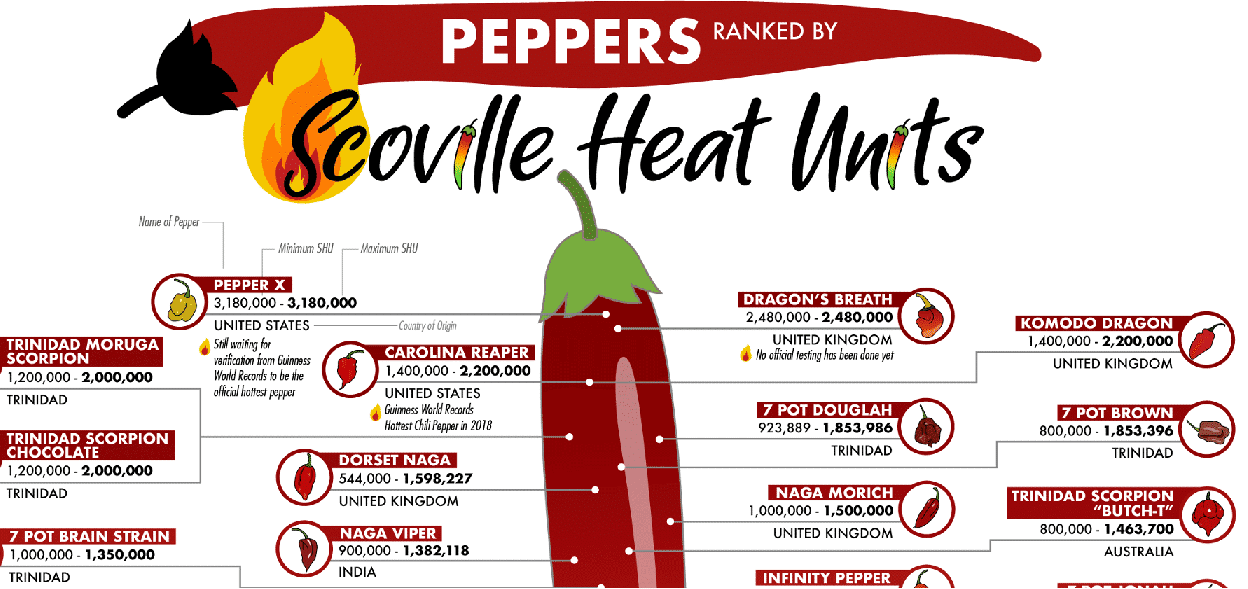
The remarkable truth about spicy food is that there is nothing hot about it at all. No heat is produced, no tissue is damaged, and yet your mouth is utterly convinced it is on fire. The culprit is capsaicin, an oily compound concentrated in the pale flesh that holds a chili's seeds. Your body is studded with tiny sensors called TRPV1 receptors, whose actual job is thermoreception, the detection of genuine, dangerous heat. They normally fire when they encounter something approaching the boiling point of water, sending an urgent pain signal to warn you away from a burn. Capsaicin binds directly to these same receptors and flips them open, tricking your nervous system into screaming that your mouth has touched something scalding. The burn is real as a sensation, but it is a case of mistaken identity, a chemical con in which no actual temperature has changed.
This same mechanism explains why reaching for a glass of water when your mouth is aflame does nothing at all. Capsaicin is an oily, fat-loving molecule that does not dissolve in water, so gulping water merely swishes the fire around and spreads it. Milk, however, works like magic. Dairy contains a protein called casein. This acts rather like a detergent, surrounding the capsaicin molecules and lifting them off your TRPV1 receptors so they can be washed away. The fat in whole milk or a spoon of yogurt helps further, since like dissolves like, and the oily capsaicin happily leaves your tongue for the fat. This is why cultures with the spiciest cuisines often pair their food with a cooling dairy companion.
The deepest puzzle is why humans, alone among mammals, actively seek out a plant that evolved capsaicin specifically to repel animals from eating it. The chili developed its heat as a defense, a chemical warning to deter the mammals whose teeth would destroy its seeds. Somewhere along the way our species learned to override the alarm and enjoy it. The leading explanation comes from psychologist Paul Rozin, who coined the phrase "benign masochism" for the peculiar human delight in experiences that feel threatening while being perfectly safe. The mind overrules the body, which believes it is in trouble even as you know you are not, the same thrill that draws people to roller coasters and horror films. When the TRPV1 alarm blares, the brain floods the body with endorphins (its natural painkillers) producing a genuine rush of pleasure much like a runner's high.
PHILOSOPHY
📚 Simone de Beauvoir and the Making of Modern Feminism
Simone de Beauvoir was born in 1908 into a respectable Parisian family. As a girl she was so pious she considered becoming a nun, yet at fourteen she suffered a crisis of faith and declared herself an atheist. Her sharp mind became her escape from a stifling upbringing. She studied philosophy at the Sorbonne, and in 1929, at just twenty-one, she sat the notoriously brutal agrégation exam. Simone became the youngest person ever to pass it placing second only to a young man named Jean-Paul Sartre. So began the most famous intellectual partnership of the twentieth century. The two never married, never lived together in the conventional sense, and never had children. Instead they struck a lifelong pact of what they called "essential" love that permitted "contingent" affairs with others, an arrangement they honored until Sartre's death.
Her masterpiece arrived in 1949. The Second Sex was a vast, meticulous examination of how women had been treated throughout history, philosophy, biology, and myth, and it sold 20,000 copies in its first week despite being condemned by the Vatican. At its heart lies one of the most quietly revolutionary sentences ever written: "One is not born, but rather becomes, a woman." With those words Beauvoir drew a line between biological sex and the social role of womanhood, arguing that femininity was not a natural essence handed down at birth. Instead it is a construction assembled by society, education, and centuries of expectation. Womanhood, she insisted, was something done to women rather than something they simply were. This single idea became the bedrock of modern feminism and still shapes how the world discusses gender today.
The engine beneath her feminism was the existentialist philosophy she helped build, often overshadowed by Sartre's fame but arguably lived more fully by her. Its central claim is that existence precedes essence: humans are born without a fixed purpose and must forge themselves through their own free choices. Beauvoir saw with piercing clarity that this freedom had been systematically denied to half of humanity, because women had been cast as the "Other," defined only in relation to men as a deviation from the male norm. She wrote unflinchingly about her mother's death, about the neglect of the elderly in Old Age, and about Sartre's painful final years. When she died in 1986, she was buried beside him in Montparnasse. She had spent a lifetime proving that a human being is not a destiny fixed by biology but a freedom waiting to be claimed, and in doing so she handed millions of women a new way to understand their own lives.

Enjoyed today’s edition?
If you found it valuable, the single best thing you can do is share it with one person who would enjoy it. Every referral helps us grow and keeps the lessons coming.
— Share A Little Wiser below —
Until next time — stay curious.
The A Little Wiser Team
