
Welcome back to A Little Wiser. We hope you are having a great week. Please feel free to reply with a topic you’d like us to cover next. Today’s wisdom explores:
The Moral Dilemma of the Trolley Problem
The Battle That Saved Western Civilization
How Jaws Created the Summer Blockbuster
Grab your coffee and let’s dive in.
PHILOSOPHY
🛒 The Moral Dilemma of the Trolley Problem
In 1967, a British philosopher named Philippa Foot published a paper on the ethics of abortion and war that contained, almost as a footnote, a thought experiment that would go on to consume moral philosophy for the next half century. Imagine a runaway trolley hurtling toward five workers on a track who have no time to move. You are standing next to a lever that will divert the trolley onto a side track, where only one worker stands. Do you pull it? Most people say yes, and the logic seems straightforward. One death is better than five. But Foot's genius was in the follow-up scenario: what if, instead of a lever, you had to physically push a large man off a bridge onto the tracks to stop the trolley and save the five? The math is identical. One life for five. Yet almost everyone recoils at the idea of pushing. The numbers are the same, but something fundamental in how we feel about it has changed.
That gap between the lever and the push is where philosophy gets genuinely uncomfortable. Utilitarian thinkers, following Jeremy Bentham and John Stuart Mill, would insist you push without hesitation, since morality is simply the arithmetic of maximizing wellbeing. But Immanuel Kant would refuse entirely, arguing that using a person as a means to an end, even a lifesaving one, violates a fundamental duty we owe to every human being. Judith Jarvis Thomson, who sharpened Foot's original thought experiment in the 1980s, introduced further variations that exposed how much our moral intuitions depend on proximity, intention, and the difference between doing harm and allowing it. In 2001, neuroscientist Joshua Greene used brain imaging to study people working through these dilemmas and found that impersonal scenarios activated the prefrontal cortex, the region associated with rational calculation, while personal scenarios lit up the amygdala and the brain's emotional processing centers. Moral judgment, it turns out, is less a coherent philosophy and more a negotiation between ancient instinct and conscious reasoning.
The thought experiment has since escaped the lecture hall in ways Foot never anticipated. Engineers designing self-driving cars have had to encode versions of this dilemma into software, deciding in advance how an autonomous vehicle should behave when a crash becomes unavoidable. A 2018 study published in Nature surveyed 2.3 million people across 233 countries and found that moral preferences varied significantly by culture, with some societies prioritizing the young, others protecting passengers over pedestrians, and others favoring inaction entirely. What Foot scribbled as a philosophical aside turned out to be a mirror held up to human nature itself, and the reflection is far more complicated than anyone expected.
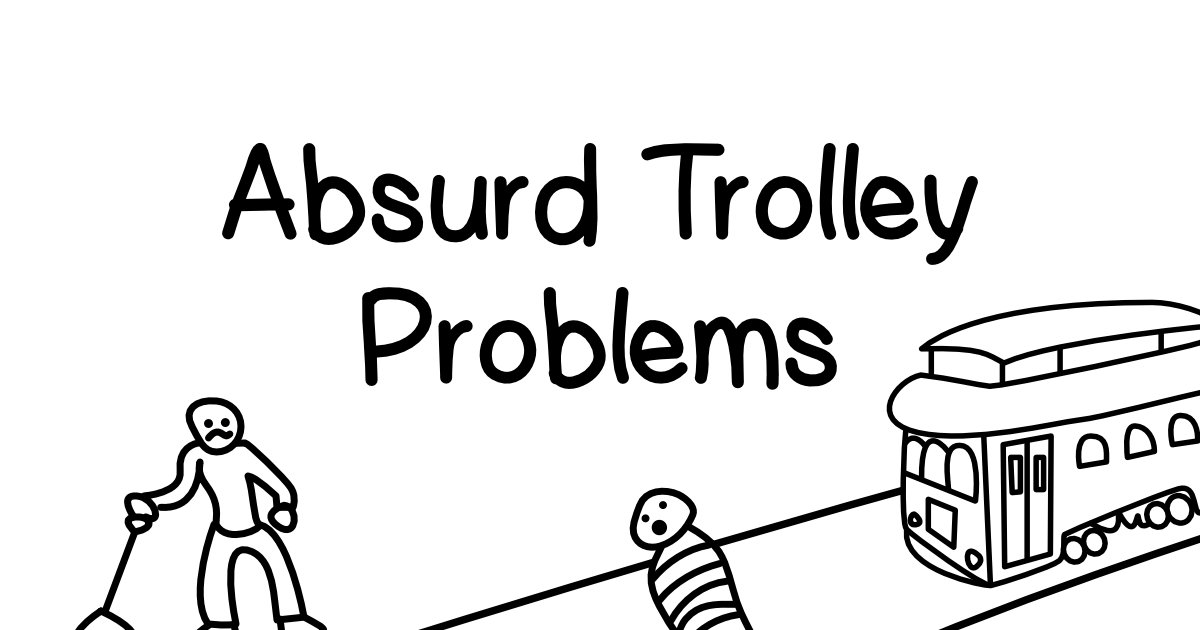
Below - test your decision-making in the trolley problem with this simple game, it shows you exactly what percentage of players made the same choices as you.
HISTORY
🗡️ The Battle That Saved Western Civilization
In October 732, somewhere between the French cities of Tours and Poitiers, two armies met on a plain that most people have never heard of and decided the future of Europe. The Umayyad Caliphate, by that point one of the largest empires the world had ever seen, had swept out of Arabia in less than a century, consumed the Persian Empire, crossed North Africa, conquered the Iberian Peninsula, and was now pushing north into the Frankish heartland. Leading the advance was Abd al-Rahman al-Ghafiqi, the Governor-General of Al-Andalus, commanding a cavalry force that had brushed aside every Christian army in its path. Standing in his way was Charles Martel, the illegitimate son of a Frankish nobleman who had clawed his way to power. He had united the fractious Frankish tribes through two decades of relentless campaigning, and arrived at Tours as the most formidable military commander in Western Europe without ever having sat on a throne.
What Martel understood, and what made the battle so consequential, was that Arab military supremacy rested entirely on its cavalry. Fast, mobile, and devastating on open ground, Umayyad horsemen had shattered opposing armies from Damascus to the Pyrenees. Martel refused to play to their strengths. He chose elevated ground, positioned his infantry in dense, interlocking formations, and waited. Ancient sources describe his men standing like a wall of ice, absorbing charge after charge without breaking. When Abd al-Rahman was killed mid-battle, possibly while trying to prevent his troops from looting the Frankish baggage train, his cavalry lost cohesion and retreated overnight. By morning, the Umayyad camp was empty.
The historian Edward Gibbon, writing in the eighteenth century, argued that had Martel lost at Tours, the teaching of the Quran would have been as inevitable in Oxford as it once was in Mecca, a line that has been quoted and debated ever since. Modern historians are more measured, noting that the Umayyad Caliphate was already overstretched and that internal divisions would likely have curtailed further expansion regardless. But the battle's symbolic and strategic importance is difficult to dismiss. It halted a momentum that had seemed unstoppable, bought the Frankish kingdoms the breathing room they needed to consolidate, and set in motion the career of a man whose grandson, Charlemagne, would go on to build the political foundation of medieval Europe. Charles Martel died a duke, never a king, but the civilization that eventually produced the Renaissance, the Enlightenment, and the modern West might look entirely different without the stand he made on that autumn afternoon in 732.

'The Battle of Tours' by Charles de Steuben, 1837
FILM
🦈 How Jaws Created the Summer Blockbuster
In Hollywood, summer used to be considered the graveyard of the film calendar. Studios released their serious prestige pictures in the fall and winter, timing them for awards season, and treated the warmer months as a dumping ground for low-budget B-movies. The assumption was that sophisticated audiences spent their summers outdoors rather than sitting in darkened theaters. Steven Spielberg's Jaws changed that assumption so completely and so suddenly that the industry never looked back. Based on Peter Benchley's 1974 novel about a great white shark terrorizing a New England beach town, the film was a production disaster by almost every measure. The mechanical shark, nicknamed Bruce by the crew, malfunctioned so persistently in the saltwater that Spielberg was forced to shoot around it, implying the creature through John Williams' two-note score and the terror on his actors' faces rather than showing it directly. The result, almost entirely by accident, was far more frightening than any rubber shark could have been.
Universal Pictures made a decision that had never been tried before at that scale, opening Jaws simultaneously on 464 screens across the country rather than the traditional approach of a gradual rollout from city to city. They paired this with a saturation television advertising campaign, buying commercial slots during prime-time broadcasts to reach audiences who had never set foot in an art house cinema. The film earned $7 million in its first weekend, a figure that stunned the industry, and went on to become the first movie in history to gross $100 million at the domestic box office. Prior to Jaws, that milestone had been considered essentially unreachable.
The consequences for Hollywood were profound and, depending on your perspective, not entirely positive. Studio executives drew what felt like an obvious lesson from Jaws and from George Lucas's Star Wars two years later: that a single wide-release film aimed at a broad audience, built around spectacle and marketed aggressively on television, could generate more revenue in a weekend than a dozen carefully crafted dramas earned in a year. The blockbuster era had begun, and with it came a gradual shift in resources away from the mid-budget, character-driven films that had defined the celebrated New Hollywood movement of the late 1960s and early 1970s. Spielberg himself later expressed ambivalence about this legacy, acknowledging that Jaws and Star Wars had, in his words, "grabbed the brass ring" in a way that restructured the entire industry around the pursuit of the next one.

Director Steven Spielberg pictured with the mechanical shark
We hope you enjoyed today’s edition! If you did, feel free to share it on social media or forward this email to friends.
Until next time... A Little Wiser Team
Key takeaways
The Moral Dilemma of the Trolley Problem
The Battle That Saved Western Civilization
How Jaws Created the Summer Blockbuster
FAQ
Q: What is The Moral Dilemma of the Trolley Problem?
A: The Moral Dilemma of the Trolley Problem is covered in this A Little Wiser edition.
Q: What is The Battle That Saved Western Civilization?
A: The Battle That Saved Western Civilization is covered in this A Little Wiser edition.
Q: What is How Jaws Created the Summer Blockbuster?
A: Please feel free to reply with a topic you’d like us to cover next.
Q: Why learn about The?
A: The Moral Dilemma of the Trolley Problem is covered in this A Little Wiser edition.
About the authors
Primary: Janet Gelder (Professor of History, University of Hawaiʻi). A Little Wiser editions are written with Lucas Garcia (Harvard Philosophy), Callum Graham (Bristol Economics), Janet Gelder (Professor of History, University of Hawaiʻi), and Louise Graham (PhD Researcher, University of Texas).