
Sponsored by

Welcome back to A Little Wiser. We hope everyone is having a great week. Please feel free to reply with a lesson you’d like to see next, we receive some great suggestions our team loves researching! Today’s wisdom explores:
The Unification of Italy
How Creole Languages Form
The Creation of 3D Printed Houses
Grab your coffee and let’s dive in.
HISTORY
🌍 The Unification of Italy
In 1850, the country we now call Italy did not exist. The peninsula was a patchwork of separate states, kingdoms, and papal territories, each with its own currency, dialect, and ruling dynasty. The Kingdom of the Two Sicilies dominated the south. The Papal States ran like a diagonal belt across the center of the peninsula, governed directly by the Catholic Church. The north was carved between the Kingdom of Sardinia-Piedmont, the Austrian-controlled territories of Lombardy and Venetia, and a scattering of smaller duchies that mostly answered to the Habsburg Empire in Vienna. The Austrians were the dominant foreign power on the peninsula, deeply invested in keeping Italy fragmented.
The unification, known in Italian as the Risorgimento, had at its center a cast of figures who could hardly have been more different from one another. Count Camillo di Cavour was the calculating Prime Minister of Piedmont-Sardinia, a man who wore his nationalism underneath a layer of diplomatic sophistication. The kingdom he served was ruled by Victor Emmanuel II, a soldier-king who possessed the legitimate authority of a crowned head that other European powers would recognize. Cavour secured a military alliance with Napoleon III's France, and in 1859 the combined Franco-Piedmontese forces drove the Austrians out of Lombardy. This brutal campaign cracked the Habsburg grip on the north and set the broader unification in motion. Standing apart from all of this diplomatic machinery was Giuseppe Garibaldi, a guerrilla commander of extraordinary personal courage. Garibaldi had little interest in kings or cabinets. He believed in a unified Italy as a matter of almost religious conviction, and he was willing to risk his life to bring it into existence.
The decisive moment came in May 1860, when Garibaldi sailed from Genoa with roughly a thousand red-shirted volunteers and landed on the western coast of Sicily. Palermo fell within weeks, the Bourbon forces were pushed off Sicily entirely, and Garibaldi crossed to the mainland. His army marched north toward Naples with such speed that King Francis II fled the city before he even arrived. Count Cavour, watching with a mixture of admiration and anxiety about what a republican revolutionary controlling southern Italy might mean for the monarchical project, dispatched the Piedmontese army southward. The tension came to a head when Garibaldi met King Victor Emmanuel II on the road at Teano in October 1860. Garibaldi had just conquered the entire south of the peninsula, was a radical hero to millions, and many feared he would keep the territory for himself. Instead, he rode up to the king, removed his hat, and shouted "I hail the King of Italy," handing over everything he had won. He refused all personal rewards before retiring to his farm on the island of Caprera. The Kingdom of Italy was formally proclaimed in March 1861, an outcome that depended, in the end, on one man's willingness to place the dream above his own ambitions and walk away.

Map of Italy 1848
Still sifting through walls of text to find an answer?

The smarter your AI chatbot of choice seems to get, the more wordy it’s response. It’s Tuesday night and you need dinner inspiration, not an essay.
heywa flips that. Ask about modern interiors, filter by your vibe and receive a visual story that actually generates new ideas.
No long paragraphs of text to crawl through, just visual inspiration that matches how we actually explore.
CULTURE
🗣️ How Creole Languages Form
In the late seventeenth century, the French colony of Saint-Domingue, the territory we now call Haiti, was importing enslaved Africans at a rate that made it one of the most brutal and economically productive plantation economies in the world. The people arriving on those ships came from dozens of different West and Central African ethnic groups, speaking Fon, Yoruba, Igbo, Wolof, and scores of other languages that were mutually unintelligible. Their French colonial overseers spoke a version of French that itself varied by region and social class. From this violent collision of languages, in conditions of extreme oppression and forced coexistence, something entirely new emerged. Haitian Creole is today the native language of over ten million people and the process by which it came into being is one of the most fascinating stories in all of linguistics.
The first stage is what linguists call a pidgin. When people who share no common language are forced into sustained contact, they develop a makeshift communication system built from fragments of whatever languages are present, typically borrowing heavily from the language of the dominant group for vocabulary while stripping out most of its grammatical complexity. A pidgin is nobody's native language. It is a practical tool, limited in scope, used for specific transactional purposes like giving instructions, trading, or negotiating. The critical transformation happens in the next generation. When children are born into a community where a pidgin is the primary shared medium of communication, they remarkably expand it. Children unconsciously add grammatical structure, tense markers, ways of expressing negation and subordinate clauses, filling in the gaps with a linguistic intuition that appears to be deeply embedded in human cognition.
What makes creole languages particularly striking to linguists is how consistent this process turns out to be across wildly different times, places, and source languages. Haitian Creole, Louisiana Creole, Tok Pisin in Papua New Guinea, Papiamento in the Caribbean: these languages formed in completely separate circumstances. Despite arising from different combinations of source languages, on different continents and centuries apart, they share structural similarities that are difficult to explain as coincidence. They tend to use word order rather than inflection to convey grammatical relationships. They tend to mark tense through separate particles placed before the verb rather than by changing the verb's ending. They tend to form questions and negations in similar ways. The similarities suggest that when human beings build a language from scratch under pressure, they converge on solutions that reflect something about the underlying architecture of the human mind. Creole languages were dismissed for centuries as broken or corrupted versions of European tongues. They are, in fact, among the most vivid demonstrations available to us of what language actually is.

Our Find of the Week:
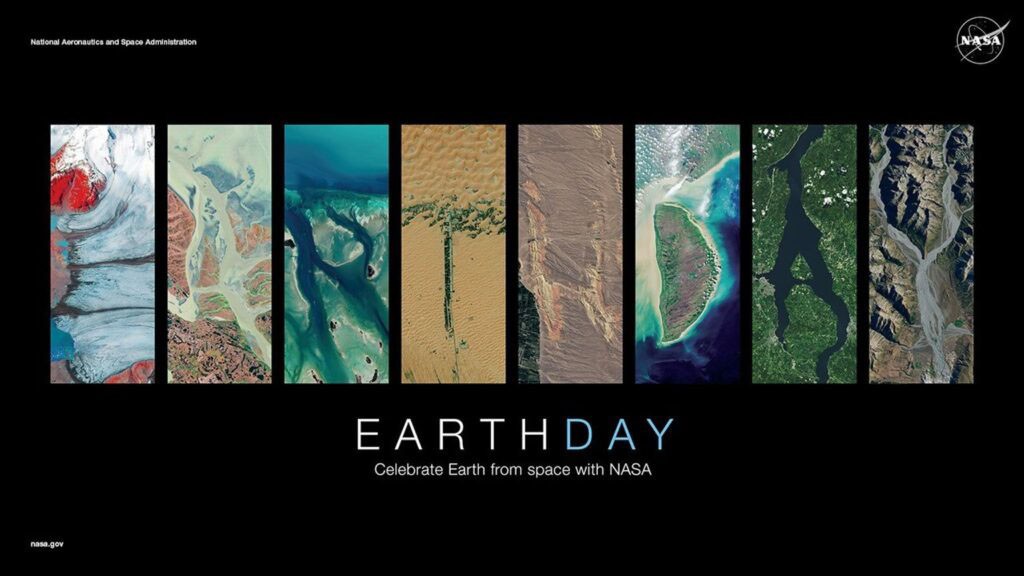
In honor of Earth Day this week, a member of our team discovered a fantastic tool from NASA that lets you spell out your name using satellite imagery of Earth. We knew our community would love it, so today’s edition features a special "Find of the Week":
Flashback Friday: 24/11/2025
ARCHITECTURE
📝 The Creation of 3D Printed Houses
The basic idea behind 3D printing a house is simpler than it sounds. A standard 3D printer builds an object by depositing material in thin layers, each one sitting on top of the last, until the final shape emerges. Construction-scale 3D printing works on the same principle, except the printer is the size of a warehouse. The machine itself is typically a large gantry system, a frame mounted on rails that spans the entire footprint of the structure, with a nozzle suspended from it that moves in precise patterns directed by software. The design is created as a digital file, translated into a set of instructions that tells the nozzle exactly where to deposit material and in what sequence. The printer then executes those instructions layer by layer, building walls from the ground up at a speed that no traditional construction crew can match. A single-story structure can have its walls printed in as little as twenty-four hours of continuous operation.
The material coming out of the nozzle has to be fluid enough to be pumped through a nozzle, but stiff enough that each layer holds its shape and supports the weight of the next one before it has fully cured. Getting this balance right is one of the central engineering challenges of the field. Different companies have developed proprietary mixes that typically combine Portland cement with fine aggregates, chemical additives that accelerate setting time, and sometimes recycled or locally sourced materials to reduce cost and environmental impact.
The promise of the technology sits at the intersection of a housing crisis and a labor shortage that most of the developed world is currently experiencing simultaneously. Traditional construction is slow, expensive and heavily dependent on skilled trades that are becoming harder to find. A 3D printed house uses only the material it needs, depositing it precisely where the design requires with almost no off-cuts or excess. Build times are dramatically shorter, and because the design exists as a digital file, it can be endlessly modified. In El Salvador, in rural Virginia, in a community outside Austin built specifically for low-income residents, printed houses are already occupied and lived in. The remaining challenges surround building codes written for conventional construction methods, insurance frameworks that do not yet know how to assess printed structures, and a construction industry with deep institutional resistance to changing the way it has always worked. The printer is ready, but the rest of the system is catching up.

3D Printed House Germany
We hope you enjoyed today’s edition! If you did, feel free to share it on social media or forward this email to friends.
Until next time... A Little Wiser Team
Key takeaways
The Unification of Italy
How Creole Languages Form
The Creation of 3D Printed Houses
FAQ
Q: What is The Unification of Italy?
A: The Unification of Italy is covered in this A Little Wiser edition.
Q: What is How Creole Languages Form?
A: How Creole Languages Form is covered in this A Little Wiser edition.
Q: What is The Creation of 3D Printed Houses?
A: Please feel free to reply with a lesson you’d like to see next, we receive some great suggestions our team loves researching!
Q: Why learn about The?
A: The Unification of Italy is covered in this A Little Wiser edition.
Sources
https://science.nasa.gov/mission/landsat/outreach/your-name-in-landsat/?utm_source=www.alittlewisernewsletter.com&utm_medium=referral&utm_campaign=today-s-wisdom-italy-creole-and-3d-printing
About the authors
Primary: Lucas Garcia (Harvard Philosophy). A Little Wiser editions are written with Lucas Garcia (Harvard Philosophy), Callum Graham (Bristol Economics), Janet Gelder (Professor of History, University of Hawaiʻi), and Louise Graham (PhD Researcher, University of Texas).